The Fundamental Principles
The real issue according to chapter ten of the Special Testimonies is diverting from the foundation of our faith, which was established at the beginning of our work.
Ellen G. White:This foundation was built by the Masterworker, and will stand storm and tempest. Will they permit this man to present doctrines that deny the past experience of the people of God? The time has come to take decided action.
SpTB02 54.2; 1904
Kellogg presented doctrines that deny the past experience. In another place, she wrote about Kellogg:
Ellen G. White:I am much worried about Dr. Kellogg. In many respects, his course is not pleasing to the Lord. It seems to be so easy for him to drift away from foundation principles. He is in great danger of not holding the beginning of his confidence steadfast unto the end.
Lt138-1902.5; 1902
The problem was the departing from the foundation principles—but not all people recognized that. Especially the key and prominent people in the work; they forgot the way the Lord led them and His teaching in the past.
Ellen G. White:I have been hoping that there would be a thorough reformation, and that the principles for which we fought in the early days, and which were brought out in the power of the Holy Spirit, would be maintained.
SpTB02 56.3; 1904
What were the principles that we fought for in the early days? What was this foundation of our faith?
Ellen G. White:As a people, we are to stand firm on the platform of eternal truth that has withstood test and trial. We are to hold to the sure pillars of our faith. The principles of truth that God has revealed to us are our only true foundation. They have made us what we are...
SpTB02 51.2; 1904
The principles of truth
that God has revealed is our only true foundation
. She is calling these principles the platform of eternal truth. She refers to these principles as the sure pillars of our faith
1.
She recalls the past experience of our pioneers, like James White, Joseph Bates, Elder Edson, father Pierce, how God worked on them until point by point
, all the principal points of our faith were made clear
. She recalled how this foundation was built by the Masterworker,
and assures that it will stand storm and tempest
. In conclusion, she strongly affirms the will of God for us regarding these principles. God calls upon us to hold firmly, with the grip of faith, to the fundamental principles that are based upon unquestionable authority
.
We see several different expressions that Sister White used for the foundation of our faith: “the platform of eternal truth,” “pillars of our faith,” “principles of truth,” “principal points,” “waymarks,” “foundation principles,” and “fundamental principles”. These expressions denote the same thing—the foundation of our faith. When we hear these expressions today, somehow they don’t convey any concrete information. But for Seventh-day Adventists in her time, this was very clear and a definite point. All of these terms are referring to the public synopsis of Seventh-day Adventist’s faith called the Fundamental Principles, further explained below.
God calls upon us to hold firmly, with the grip of faith, to the fundamental principles that are based upon unquestionable authority.
This is a reference to principal features of Seventh-day Adventist faith which God revealed to Adventist pioneers after the passing of the time in 1844,
when a group of keen, noble, and true men searched for the truth as for hidden treasure.
This was the foundation of our faith. Our pioneers officially established the Seventh-day Adventist Church in 1863, and they taught these truths which they called “fundamental principles.” But often, Seventh-day Adventists were misrepresented publicly. For this reason, in 1872, our pioneers published a document called “A Declaration of the Fundamental Principles, Taught and Practiced by the Seventh-day Adventists” in order to publicly, but briefly, declare what fundamental principles Seventh-day Adventists taught and practiced. These Fundamental Principles were regularly printed as a standalone pamphlet, were present in our papers, and were annually printed in Adventist Yearbooks throughout Ellen White's lifetime.2 Therefore, when Ellen White referenced the “fundamental principles,” this was not a vague or opaque statement, since the Seventh-day Adventist church had officially and publicly declared what these fundamental principles were. In the preface of this document, we read the purpose behind this document.
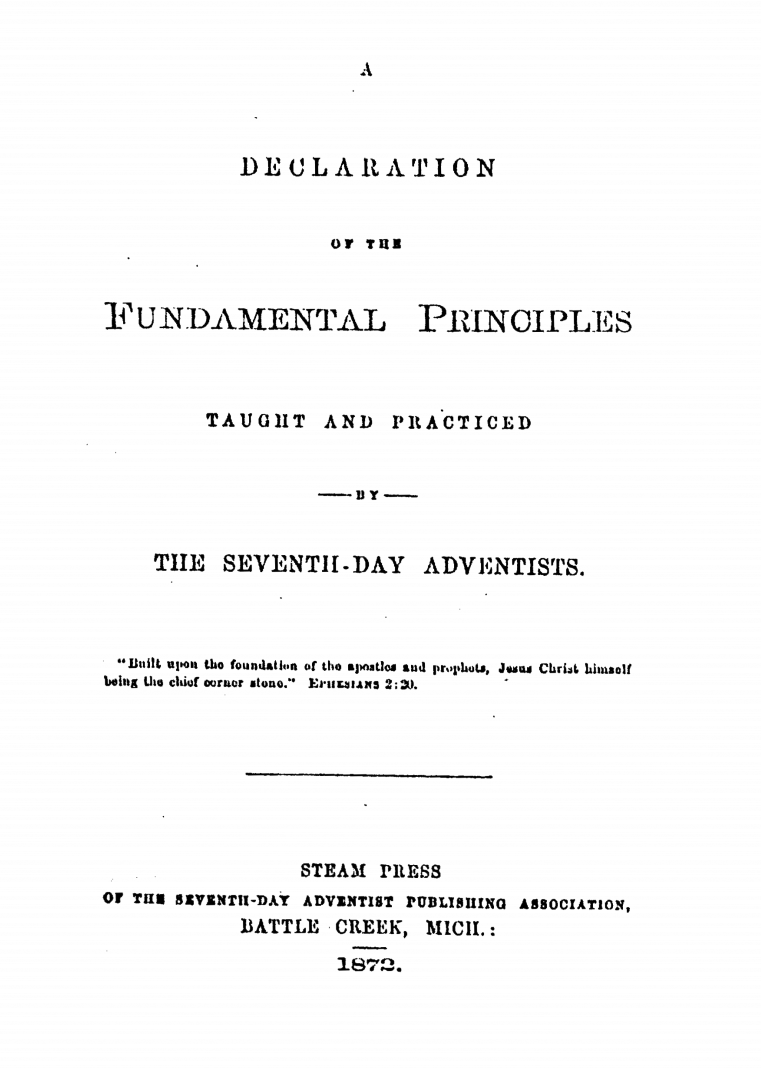
Quotation:In presenting to the public this synopsis of our faith, we wish to have it distinctly understood that we have no articles of faith, creed, or discipline, aside from the Bible. We do not put forth this as having any authority with our people, nor is it designed to secure uniformity among them, as a system of faith, but is a brief statement of what is, and has been, with great unanimity, held by them. We often find it necessary to meet inquiries on this subject, and sometimes to correct false statements circulated against us, and to remove erroneous impressions which have obtained with those who have not had an opportunity to become acquainted with our faith and practice. Our only object is to meet this necessity.
Quotation:As Seventh-day Adventists we desire simply that our position shall be understood; and we are the more solicitous for this because there are many who call themselves Adventists who hold views with which we can have no sympathy, some of which, we think, are subversive of the plainest and most important principles set forth in the word of God...
The Fundamental Principles 1872, p. 3.1
This synopsis of faith consisted of 25 points, which represented what is, and has been, with great unanimity, held by
Seventh-day Adventists. These 25 points constituted the foundation that was laid at the beginning of our work by prayerful study of the word and by revelation
. In 1904, Sister White told us that upon this foundation we have been building for the past fifty years.
These are the the fundamental principles that are based upon unquestionable authority
, that God calls upon us to hold firmly, with the grip of faith
. In other words, she repeated, we are to hold to the sure pillars of our faith
.
In 1904, Sister White wrote aboutthe efforts of the enemy to undermine the foundation of our faith
. She wrote about the movement that wouldconsist in giving up the doctrines which stand as the pillars of our faith
. This reformation, if accepted, would discardthe principles of truth that God in His wisdom has given to the remnant church
andthe fundamental principles that have sustained the work for the last fifty years would be accounted as error
. This movement started about the time when Dr. John H. Kellogg published the book, “Living Temple”.
Ellen G. White:About the time that ‘Living Temple’ was published, there passed before me in the night season, representations indicating that some danger was approaching, and that I must prepare for it by writing out the things God has revealed to me regarding the foundation principles of our faith.
SpTB02 52.3; 1904
By publishing “Living Temple”, foundation principles of our faith would be underminedthrough the dissemination of seductive theories
contained therein.
Ellen G. White:I have been instructed by the heavenly messenger that some of the reasoning in the book, ‘Living Temple,’ is unsound and that this reasoning would lead astray the minds of those who are not thoroughly established on the foundation principles of present truth. It introduces that which is naught but speculation in regard to the personality of God and where His presence is.
SpTB02 51.3; 1904
Sister White is very particular in pointing out that the reasoning contained in the book Living Temple,would lead astray
from thethe foundation principles of present truth
. These reasonings are inregard to the personality of God and where His presence is
.
As mentioned before, the word ‘personality’, in the context of the nineteenth century, is defined as “the quality or state of being a person”3. In other words, this term conveys the answer to the question, “what is it that defines someone to be a person?”, “What is the quality or state of someone being a person?” In the case of the personality of God, the question is, “Is God a person and what is it that defines Him as being a person? What is the quality or state of God being a person?”
The reasoning of Dr. Kellogg regarding these questions expressed in the book Living Temple, isunsound
. The sentiments, inregard to the personality of God and where His presence is
,advocated in the book, did not bear the indorsement of God, and that they were a snare that the enemy had prepared for the last days
. As we are living in the last days, we ought to ask ourselves these questions. Likewise, we are to question the biblical validity of the statements in the Fundamental Principles regarding the personality of God and where His presence is. How do the Fundamental Principles define God as being a person, and what do they say regarding God’s presence?
The first point listed below deals with the personality of God and His presence. The second point gives the context to the first. Please consider a few questions while reading them: Who is referred to as one God? How is God defined as a person or in other words, what is the quality or state of Him being a person? How do these points talk about the presence of God?
Quotation:“I – That there is one God, a personal, spiritual being, the creator of all things, omnipotent, omniscient, and eternal, infinite in wisdom, holiness, justice, goodness, truth, and mercy; unchangeable, and everywhere present by his representative, the Holy Spirit. Ps. 139:7.”
Quotation:II – That there is one Lord Jesus Christ, the Son of the Eternal Father, the one by whom God created all things, and by whom they do consist; …”
The Fundamental Principles 1889, point no. 1.,2.,.
In the time of Ellen White, Seventh-day Adventists believed in one God—a personal, spiritual being, the Creator of all things—and they believed that this God created everything by His Son Jesus Christ. They addressed the Father as one God, and they addressed Christ as the Son of God. The quality or state of God being a person is expressed in the term “personal, spiritual being”. Regarding His presence, the Fundamental Principles state that He is everywhere present by His representative, the Holy Spirit. The meaning of these principles requires very special attention. Keeping within the historical context, this will be the subject of our following studies.
The Test
Most obviously, these fundamental principles do not contain the doctrine of the Trinity! More precisely, the sentiments “three in one,” or “one in three”, in reference to God, are nowhere to be found—which are present in today’s Fundamental Beliefs. Only the Father is referred to as “one God’‘. But before rushing to swift conclusions, and condemning the doctrine of the Trinity asseductive theories,
whichundermine the foundation of our faith
, please bear in mind that Sister White presents a comprehensive list of characteristics that must be fulfilled in order for it to be deemed as such.
If the Trinity doctrine is questionable, then the trinitarian sentiments would need to:
- rob the people of God of their past experience
- destroy the personality of God
- tear down the pillars of our faith or lead astray from the foundation principles
- be presented as if Mrs. White supported them
It is not our intention to deal with any of Kellogg’s seductive theories, but rather to study the personality of God in its historical background. As we do this, we will face the evidence of Sister White reactively warning the church of these characteristics.
A strong foundation God has laid
Without a doubt it cannot fade
Through earnest prayer and study deep
The truths revealed we now must keep
There is one God, He’s personal
With form, but also spiritual
His Spirit present everywhere
God is all-knowing, all-aware.
Our Father, the Eternal One
By Christ His dear begotten Son
Created all that does exist.
These precious truths let’s not resist
When men step off the platform firm
And strange new teachings they would learn
Then doctrines false with truth combine
God’s principles they undermine
Hold firm the truth with faithful grip
Let not these anchors ever slip
For what God wrought through pioneer’s hands
Through time and tempest ever stands.
Notes
- 1
- 2See Fundamental Principles - Timeline for more details. ↩
- 3Merriam-Webster Dictionary, word ‘personality’ ↩
- 4
- 5From 1872 until 1914, the Fundamental Principles remained constant and unchanged, with the exception in 1889, when James Smith added three new points. But during all those years, the points concerning “the personality of God” and “where His presence is” remained the same. ↩