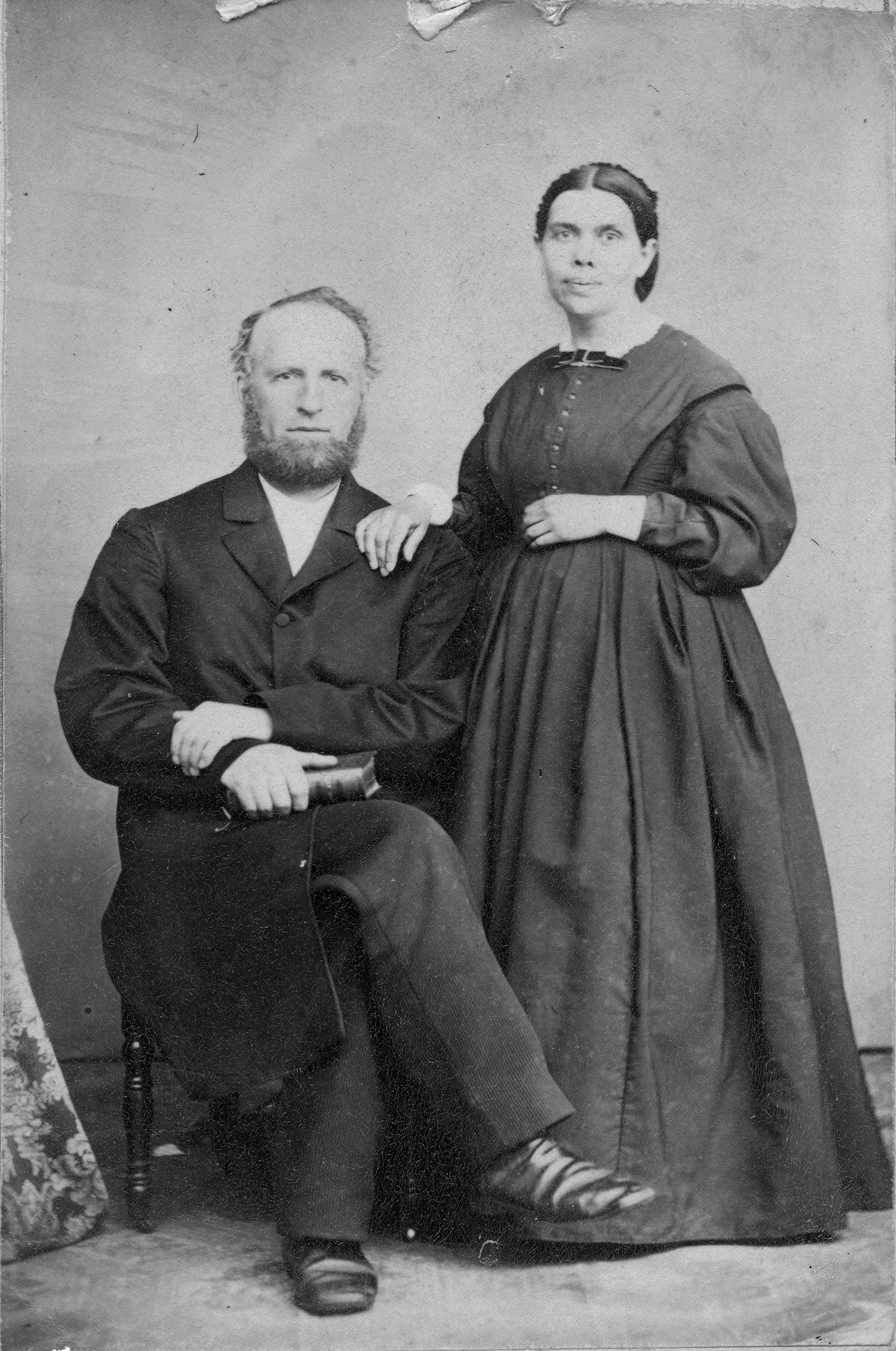
The personality of God - by James S. White
In what follows, we will examine James White’s pamphlet titled “The Personality of God”. When we read this article, we will see that James White continues where Brother Loughborough left off, and that he expands and deepens the understanding behind the first point of the Fundamental Principles.
James White’s tract was printed multiple times, advertised 54 times, and reprinted twice in the Review and Herald publication. His view on the personality of God was well known and spread throughout Adventism. In this pamphlet, we will see clear criticism toward the ideas that Kellogg advocated in the Living Temple.
Quotation:MAN was made in the image of God. ‘And God said, Let us make man in our image, after our likeness.’ ‘So God created man in his own image, in the image of God created he him.’ Genesis 1:26, 27. See also chap. 9:6; 1 Corinthians 11:7. Those who deny the personality of God, say that ‘image’ here does not mean physical form, but moral image, and they make this the grand starting point to prove the immortality of all men. The argument stands thus: First, man was made in God’s moral image. Second, God is an immortal being. Third, therefore all men are immortal. But this mode of reasoning would also prove man omnipotent, omniscient, and omnipresent, and thus clothe mortal man with all the attributes of the deity. Let us try it: First, man was made in God’s moral image. Second, God is omnipotent, omniscient, and omnipresent. Third, therefore, man is omnipotent, omniscient, and omnipresent. That which proves too much, proves nothing to the point, therefore the position that the image of God means his moral image, cannot be sustained. As proof that God is a person, read his own words to Moses: ‘And the Lord said, Behold there is a place by me, and thou shalt stand upon a rock; and it shall come to pass, while my glory passeth by, that I will put thee in a cleft of the rock, and will cover thee with my hand while I pass by. And I will take away mine hand and thou shalt see my back parts; but my face shall not be seen.’ Exodus 33:21-23. See also chap. 24:9-11. Here God tells Moses that he shall see his form. To say that God made it appear to Moses that he saw his form, when he has no form, is charging God with adding to falsehood a sort of juggling deception upon his servant Moses.
James S. White, PERGO 1.1; 1861
Quotation:But the skeptic thinks he sees a contradiction between verse 11, which says that the Lord spake unto Moses face to face, and verse 20, which states that Moses could not see his face. But let Numbers 12:5-8 remove the difficulty. ‘And the Lord came down in the pillar of the cloud, and stood in the door of the tabernacle, and called Aaron and Miriam, and they both came forth. And he said, Hear now my words. If there be a prophet among you, I, the Lord, will make myself known unto him in a vision, and will speak unto him in a dream. My servant Moses is not so, who is faithful in all mine house. With him will I speak mouth to mouth, even apparently.’
James S. White, PERGO 2.1; 1861
Quotation:The great and dreadful God came down, wrapped in a cloud of glory. This cloud could be seen, but not the face which possesses more dazzling brightness than a thousand suns. Under these circumstances Moses was permitted to draw near and converse with God face to face, or mouth to mouth, even apparently.
James S. White, PERGO 2.2; 1861
Quotation:Says the prophet Daniel, ‘I beheld till the thrones were cast down, and the Ancient of days did sit, whose garment was white as snow, and the hairs of his head like the pure wool; his throne was like the fiery flame, and his wheels as burning fire.’ Chap. 7:9. ‘I saw in the night visions, and, behold, one like the Son of man came with the clouds of heaven, and came to the Ancient of days, and they brought him near before him, and there was given him dominion and glory and a kingdom.’ Verses 13, 14.
James S. White, PERGO 2.3; 1861
Quotation:Here is a sublime description of the action of two personages; viz, God the Father, and his Son Jesus Christ. Deny their personality, and there is not a distinct idea in these quotations from Daniel. In connection with this quotation read the apostle’s declaration that the Son was in the express image of his Father’s person. ‘God, who at sundry times, and in divers manners, spake in time past unto the fathers by the prophets, hath in these last days spoken unto us by his Son, whom he hath appointed heir of all things, by whom also he made the worlds; who being the brightness of his glory, and the express image of his person.’ Hebrews 1:1-3.
James S. White, PERGO 3.1; 1861
Quotation:We here add the testimony of Christ. ‘And the Father himself which hath sent me, hath borne witness of me. Ye have neither heard his voice at any time, nor seen his shape.’ John 5:37. See also Philippians 2:6. To say that the Father has not a personal shape, seems the most pointed contradiction of plain scripture terms.
James S. White, PERGO 3.2; 1861
OBJECTION. - ‘God is a Spirit.’ John 4:24.
Quotation:ANSWER. - Angels are also spirits [Psalm 104:4], yet those that visited Abram and Lot, lay down, ate, and took hold of Lot’s hand. They were spirit beings. So is God a Spirit being.
James S. White, PERGO 3.3; 1861
Quotation:OBJ. - God is everywhere. Proof. Psalm 139:1-8. He is as much in every place as in any one place.
James S. White, PERGO 3.4; 1861
Quotation:ANS. - 1. God is everywhere by virtue of his omniscience, as will be seen by the very words of David referred to above. Verses 1-6. ‘O Lord, thou hast searched me, and known me. Thou knowest my down-sitting and mine uprising; thou understandest my thought afar off. Thou compassest my path and my lying down, and art acquainted with all my ways. For there is not a word in my tongue, but, lo, O Lord, thou knowest it altogether. Thou hast beset me behind and before, and laid thy hand upon me. Such knowledge is too wonderful for me. It is high; I cannot attain unto it.’
James S. White, PERGO 3.5; 1861
Quotation:2. God is everywhere by virtue of his Spirit, which is his representative, and is manifested wherever he pleases, as will be seen by the very words the objector claims, referred to above. Verses 7-10. ‘Whither shall I go from thy Spirit? or whither shall I flee from thy presence? If I ascend up into heaven, thou art there; if I make my bed in hell, behold, thou art there. If I take the wings of the morning, and dwell in the uttermost parts of the sea, even there shall thy hand lead me, and thy right hand shall hold me.’
James S. White, PERGO 4.1; 1861
Quotation:God is in heaven. This we are taught in the Lord’s prayer. ‘Our Father which art in heaven.’ Matthew 6:9; Luke 11:2. But if God is as much in every place as he is in any one place, then heaven is also as much in every place as it is in any one place, and the idea of going to heaven is all a mistake. We are all in heaven; and the Lord’s prayer, according to this foggy theology simply means, Our Father which art everywhere, hallowed be thy name. Thy kingdom come, thy will be done, on earth, as it is everywhere.
James S. White, PERGO 4.2; 1861
Quotation:Again, Bible readers have believed that Enoch and Elijah were really taken up to God in heaven. But if God and heaven be as much in every place as in any one place, this is all a mistake. They were not translated. And all that is said about the chariot of fire, and horses of fire, and the attending whirlwind to take Elijah up into heaven, was a useless parade. They only evaporated, and a misty vapor passed through the entire universe. This is all of Enoch and Elijah that the mind can possibly grasp, admitting that God and heaven are no more in any one place than in every place. But it is said of Elijah that he ‘went up by a whirlwind into heaven.’ 2 Kings 2:11. And of Enoch it is said that he ‘walked with God, and was not, for God took him.’ Genesis 5:24.
James S. White, PERGO 4.3; 1861
Quotation:Jesus is said to be on the right hand of the Majesty on high. Hebrews 1:3. ‘So, then, after the Lord had spoken unto them he was received up into heaven, and sat on the right hand of God.’ Mark 16:19. But if heaven be everywhere, and God everywhere, then Christ’s ascension up to heaven, at the Father’s right hand, simply means that he went everywhere! He was only taken up where the cloud hid him from the gaze of his disciples, and then evaporated and went everywhere! So that instead of the lovely Jesus, so beautifully described in both Testaments, we have only a sort of essence dispersed through the entire universe. And in harmony with this rarified theology, Christ’s second advent, or his return, would be the condensation of this essence to some locality, say the mount of Olivet! Christ arose from the dead with a physical form. ‘He is not here,’ said the angel, ‘for he is risen as he said.’ Matthew 28:6.
James S. White, PERGO 5.1; 1861
Quotation:‘And as they went to tell his disciples, behold, Jesus met them, saying, All hail! And they came and held him by the feet, and they worshiped him.’ Verse 9.
James S. White, PERGO 5.2; 1861
Quotation:‘Behold my hands and my feet,’ said Jesus to those who stood in doubt of his resurrection, ‘that it is I myself. Handle me and see, for a spirit hath not flesh and bones as ye see me have. And when he had thus spoken, he showed them his hands and his feet. And while they yet believed not for joy, and wondered, he said unto them, Have ye here any meat? And they gave him a piece of broiled fish, and of an honey-comb, and he took it and did eat before them.’ Luke 24:39-43.
James S. White, PERGO 5.3; 1861
Quotation:After Jesus addressed his disciples on the mount of Olivet, he was taken up from them, and a cloud received him out of their sight. ‘And while they looked steadfastly toward heaven as he went up, behold two men stood by them in white apparel, which also said, Ye men of Galilee, why stand ye gazing up into heaven? This same Jesus which is taken up from you into heaven, shall so come in like manner as ye have seen him go into heaven.’ Acts 1:9-11. J. W.
James S. White, PERGO 6.1; 1861
James White fights the idea that God is just a spirit, and as such, is present as much in every place as in any one place
. He gives plain and positive testimony from Scripture that God is a personal being; we see the very same sentiments in Ellen White’s writings.
Ellen G. White:The mighty power that works through all nature and sustains all things is not, as some men of science claim, merely an all-pervading principle, an actuating energy. God is a spirit; yet He is a personal being, for man was made in His image. As a personal being, God has revealed Himself in His Son. Jesus, the outshining of the Father’s glory, “and the express image of His person” (Hebrews 1:3), was on earth found in fashion as a man. As a personal Saviour He came to the world. As a personal Saviour He ascended on high. As a personal Saviour He intercedes in the heavenly courts. Before the throne of God in our behalf ministers “One like the Son of man.” Daniel 7:13.
Ed 131.5; 1903
Ellen White and the Adventist pioneers made a distinction between the terms ‘spirit’ and ‘being’. God is a personal being, not just a spirit. He is notas much in every place as in any one place
, but He isin one place more than another
John. N. Loughborough, “Is God a Person?” The Adventist Review and Sabbath Herald, September 18, 1855. He is in heaven, in His temple, sitting on His throne—in person—and He is everywhere present by His representative, the Holy Spirit.
Here are some other quotations from Sister White that are in harmony with the pioneers’ views on the personality of God:
Ellen G. White:He [Jesus] taught that God was a rewarder of the righteous, and a punisher of the transgressor. He was not an intangible spirit, but a living ruler of the universe. This gracious Father was constantly working for the good of man, and mindful of all that concerns him...
3SP 47.1; 1878
Ellen G. White:The Bible shows us God in His high and holy place, not in a state of inactivity, not in silence and solitude, but surrounded by ten thousand times ten thousand and thousands of thousands of holy beings, all waiting to do His will. Through these messengers He is in active communication with every part of His dominion. By His Spirit He is everywhere present. Through the agency of His Spirit and His angels He ministers to the children of men.
MH 417.2; 1905
Ellen G. White:The greatness of God is to us incomprehensible. ‘The Lord’s throne is in heaven’ (Psalm 11:4); yet by His Spirit He is everywhere present. He has an intimate knowledge of, and a personal interest in, all the works of His hand.
Ed 132.2; 1903
Ellen G. White:Through Jesus Christ, God—not a perfume, not something intangible, but a personal God—created man and endowed him with intelligence and power.
Ms117-1898.10; 1898
Continuing in James White’s pamphlet, we read his sharp criticism on the notion of an immaterial God. Before that, let’s briefly recall Dr. Kellogg’s argument thatDiscussions respecting the form of God are utterly unprofitable
Dr. John H. Kellogg, The Living Temple, p.33. because God isfar beyond our comprehension as are the bounds of space and time
. He believed that God’s person is not constrained to one locality because He is inas much in every place as in any one place
James S. White, PERGO 4.3; 1861 1. If God in His personality were truly a definite being, having a tangible body, then He would not be able to be presentas much in every place as in any one place
and, thus, sustain life. James White continues against the reasoning that God is immaterial in His person.
Quotation:IMMATERIALITY
Quotation:THIS is but another name for nonentity. It is the negative of all things and beings - of all existence. There is not one particle of proof to be advanced to establish its existence. It has no way to manifest itself to any intelligence in heaven or on earth. Neither God, angels, nor men could possibly conceive of such a substance, being, or thing. It possesses no property or power by which to make itself manifest to any intelligent being in the universe. Reason and analogy never scan it, or even conceive of it. Revelation never reveals it, nor do any of our senses witness its existence. It cannot be seen, felt, heard, tasted, or smelled, even by the strongest organs, or the most acute sensibilities. It is neither liquid nor solid, soft nor hard - it can neither extend nor contract. In short, it can exert no influence whatever - it can neither act nor be acted upon. And even if it does exist, it can be of no possible use. It possesses no one, desirable property, faculty, or use, yet, strange to say, immateriality is the modern Christian’s God, his anticipated heaven, his immortal self - his all!
James S. White, PERGO 6.2; 1861
Quotation:O sectarianism! O atheism!! O annihilation!!! who can perceive the nice shades of difference between the one and the other? They seem alike, all but in name. The atheist has no God. The sectarian has a God without body or parts. Who can define the difference? For our part we do not perceive a difference of a single hair; they both claim to be the negative of all things which exist - and both are equally powerless and unknown.
James S. White, PERGO 6.3; 1861
Quotation:The atheist has no after life, or conscious existence beyond the grave. The sectarian has one, but it is immaterial, like his God; and without body or parts. Here again both are negative, and both arrive at the same point. Their faith and hope amount to the same; only it is expressed by different terms.
James S. White, PERGO 7.1; 1861
Quotation:Again, the atheist has no heaven in eternity. The sectarian has one, but it is immaterial in all its properties, and is therefore the negative of all riches and substances. Here again they are equal, and arrive at the same point.
James S. White, PERGO 7.2; 1861
Quotation:As we do not envy them the possession of all they claim, we will now leave them in the quiet and undisturbed enjoyment of the same, and proceed to examine the portion still left for the despised materialist to enjoy.
James S. White, PERGO 7.3; 1861
Quotation:What is God? He is material, organized intelligence, possessing both body and parts. Man is in his image.
James S. White, PERGO 7.4; 1861
Quotation:What is Jesus Christ? He is the Son of God, and is like his Father, being ‘the brightness of his Father’s glory, and the express image of his person.’ He is a material intelligence, with body, parts, and passions; possessing immortal flesh and immortal bones.
James S. White, PERGO 7.5; 1861
Quotation:What are men? They are the offspring of Adam. They are capable of receiving intelligence and exaltation to such a degree as to be raised from the dead with a body like that of Jesus Christ, and to possess immortal flesh and bones. Thus perfected, they will possess the material universe, that is, the earth, as their ‘everlasting inheritance.’ With these hopes and prospects before us, we say to the Christian world who hold to immateriality, that they are welcome to their God - their life - their heaven, and their all. They claim nothing but that which we throw away; and we claim nothing but that which they throw away. Therefore, there is no ground for quarrel or contention between us.
James S. White, PERGO 7.6; 1861
Quotation:We choose all substance - what remains
James S. White, PERGO 8.1; 1861
The mystical sectarian gains;
All that each claims, each shall possess,
Nor grudge each other’s happiness.
An immaterial God they choose,
For such a God we have no use;
An immaterial heaven and hell,
In such a heaven we cannot dwell.
We claim the earth, the air, and sky,
And all the starry worlds on high;
Gold, silver, ore, and precious stones,
And bodies made of flesh and bones.
Such is our hope, our heaven, our all,
When once redeemed from Adam’s fall;
All things are ours, and we shall be,
The Lord’s to all eternity.
James White compared the sentiments on the immaterial God with sectarianism, atheism, and annihilation. “Immaterial God” is another expression for the nonentity of God. James White never received any reproof from Sister White for these views; rather, they were supported by her writings. Many assert that Sister White changed her views over time and, later, accepted the Trinity doctrine, but this is not backed up by detailed historical records. In 1905, Sister White recalls the occasion with Dr. Kellogg when, twenty years prior, he came to her with the very sentiments regarding the personality of God that James White and other pioneers were refuting:
Ellen G. White:Now this subject has been kept before me for more than twenty years. My husband has been dead twenty years, and before he died, things came in. Dr. Kellogg came into my room; I was occupying one of the large rooms at the office as my home. I had two or three rooms there, and he got a great light; and he sat down and told what his light was: it is just the same theories or errors, the same sophistries, that he is presenting, and did present in ‘Living Temple.’ I said, ‘Dr. Kellogg, I have met that.’ I met it when I first started out to travel. I met it in the North; I met it in New Hampshire. I saw the curse of its influence in Massachusetts, and the testimonies that were given to me were right to the point that we were not to have anything of this kind to be taught in our churches. And I talked with him. I gave the history—I have not time to give it to you here. I gave him the history of how that was treated by the Spirit of God, and how we as a people must escape the sophistries and delusions. And it was ministers that were deceiving the people with these sophistries. I will not tell you what they led to—it may have to come; but I will not tell you now what they led to; but I will tell you what this sophistry leads to: It leads to the nonentity of Christ, to the nonentity of God, his personality, and brings in,—what shall I call it?—a sort of manufactured theory of God and Christ.
Ms70a-1905.11; 1905
Kellogg’s sentiment in the Living Temple regarding the personality of God leads to the nonentity of Christ and the nonentity of God. Why? Because his views of God claim an immaterial God. The church was faced with such sentiments in the beginning of their work. James White wrote about them in his pamphlet “The Personality of God”, and Sister White recalled these early experiences when she and her husband combatted the error that God is an immaterial, all-prevailing spirit.
Notes
- 1In the Living Temple, Dr. Kellogg objected that God cannot be everywhere presente at once: “Says one, ‘God may be present by his Spirit, or by his power, but certainly God himself cannot be present everywhere at once.’ We answer: How can power be separated from the source of power? Where God’s Spirit is at work, where God’s power is manifested, God himself is actually and truly present…” John H. Kellogg, The Living Temple, p.28. ↩